How to start planning the Camino de Santiago?
Planning your Camino de Santiago may seem overwhelming at first, but with the right steps it becomes a simple and exciting process. The key is to make five fundamental decisions in the right order: when to go, which route to choose, how many days to walk, where to sleep, and how to organize logistics.
In this guide we explain step by step how to plan your trip to the Camino de Santiago, from the first idea to the day of departure, so you only have to worry about enjoying the experience.
Want to organise the Camino de Santiago step by step?
At Santiago Ways, we organise Camino de Santiago routes with selected accommodation, luggage transfer and assistance throughout the journey, so you can simply focus on enjoying the experience.
Step 1: Choose when to do the Way of St. James
The time of year determines the weather, the availability of lodging and the number of pilgrims on the Camino.
Best time to do the Camino de Santiago
Spring (April-June):
- Pleasant climate (15-22°C)
- Nature in full splendor
- Less overcrowding than in summer
- Ideal for: First time, families, leisurely pace.
Summer (July-August):
- High temperatures (25-35°C)
- Increased influx of pilgrims
- All services open
- Reservations 2-3 months in advance
- Ideal for: Social environment, school vacations
Autumn (September-October):
- Stable and pleasant climate
- Fewer people than in summer
- Spectacular autumn landscapes
- Good availability
- Ideal for: Balanced experience, photography
Winter (November-March):
- Low temperatures (5-12°C)
- Few pilgrims (intimate experience)
- Some shelters closed
- Ideal for: Experienced pilgrims, introspection.
Recommendation: If it’s your first time, choose May, June or September to enjoy the best balance between climate, services and atmosphere.
Request a personalized quote
Step 2: Decide which route of the Camino de Santiago to take.
There are multiple routes to Santiago de Compostela. The choice depends on your available days, physical level and the type of experience you are looking for.
Main routes of the Camino de Santiago
Camino Frances(800 km from Saint-Jean-Pied-de-Port)
- The most popular route with the best infrastructure
- Varied landscapes: Pyrenees, high plateau, Galician mountains
- Excellent pilgrim environment
- Complete services at each stage
- Recommended duration: 30-35 days full / 5-7 days from Sarria.
- Ideal for: First time, safety, socializing.
Portuguese Way (240 km from Oporto)
- Second busiest route
- Mild climate, flat terrain
- Rich Portuguese and Galician gastronomy
- Two variants: Interior and Coastal
- Recommended duration: 10-12 days from Porto / 6-7 days from Tui.
- Ideal for: Comfortable rhythm, gastronomy, culture.
North Road (825 km from Irún)
- Spectacular coastal route
- More physically demanding (slopes)
- Less crowded
- Beaches and cliffs of the Bay of Biscay
- Recommended duration: 32-35 days
- Ideal for: Experienced pilgrims, nature
Primitive Way (320 km from Oviedo)
- The oldest route
- Demanding: mountainous and solitary
- Wild and authentic landscapes
- Less infrastructure
- Recommended duration: 13-15 days
- Ideal for: Adventurers, contemplative experience.
English Way (120 km from Ferrol)
- Short and less known route
- Galician coastal landscapes
- Quiet and well signposted
- Recommended duration: 5-6 days
- Ideal for: Short time, first experience

Which route to choose according to your available days?
| Days available | Recommended route | Starting point |
|---|---|---|
| 5-7 days | Camino Francés | Sarria (114 km) |
| 6-8 days | Camino Inglés | Ferrol (120 km) |
| 10-12 days | Camino Portugués | Oporto (240 km) |
| 12-15 days | Camino Primitivo | Oviedo (320 km) |
| 12-15 days | Camino Francés completo | Saint-Jean (800 km) |
Step 3: Define your pace and number of days
Once you have chosen the route, you must decide how many kilometers to walk each day according to your physical condition and travel style.
Recommended rhythms to plan your Camino a Santiago
Fast pace (22-28 km/day):
- Requires good physical fitness
- Less time to enjoy villages
- Ideal for experienced pilgrims
- Example: Sarria-Santiago in 5 days
Standard pace (18-22 km/day):
- Balance between effort and enjoyment
- Time for sightseeing
- Most popular option
- Example: Sarria-Santiago in 6 days
Comfortable pace (15-18 km/day):
- Slow and contemplative experience
- Ideal for the first time
- Enjoys gastronomy and culture
- Example: Sarria-Santiago in 7 days
Quiet pace (10-15 km/day):
- Minimal physical effort
- Profound experience
- Perfect for families or reduced mobility
- Example: Sarria-Santiago in 8+ days
Advice: If this is your first Camino de Santiago, choose a comfortable pace (15-18 km/day). You can always increase distances if you feel good.
Step 4: Plan your accommodation
You have two main options: public hostels or private accommodation by reservation.
Public shelters
Advantages:
- Economic
- Authentic pilgrim atmosphere
- Meet other walkers
Disadvantages:
- No reservation (first come, first served)
- Shared bunk beds
- Common bathrooms
- Can be filled in high season
Private accommodation (hotels, guesthouses, private hostels)
Advantages:
- Guaranteed reservation
- Private rooms with bathroom
- Greater comfort and relaxation
- Flexibility of schedules
Disadvantages:
- Increased investment
- Less spontaneous interaction
Which option to choose?
- First time or high season: Accommodation with reservation (avoids stress and guarantees rest).
- Authentic experience and tight budget: Public hostels
- Combination: Hostels on weekdays + hotels on weekends.

Step 5: Organize travel logistics
Luggage transfer
Carrying a full backpack every day can be exhausting. The luggage transfer service allows you to walk with only the essentials.
How it works:
- You leave your backpack at reception every morning
- It is picked up and taken to the next lodging
- You walk lightly with a small backpack
Recommended for: First time, +50 years old, previous injuries, enjoyment without load.
Transportation to the starting point
Main starting points and how to get there:
- Sarria(Camino Frances): Train from Santiago, A Coruña or Madrid.
- Porto(Portuguese Way): Direct flight or train from Lisbon
- Saint-Jean-Pied-de-Port(complete Camino Frances): Train from Bayonne or Pamplona
- Ferrol(English Way): Bus from Santiago or A Coruña
Travel insurance
Although it is not mandatory, it is highly advisable to take out insurance coverage:
- Medical assistance
- Repatriation
- Trip cancellation
- Loss of baggage
- Accidents on the road
Pilgrim’s credential
Official document that is stamped at each stage and allows:
- Access to public shelters
- Obtaining the Compostela in Santiago
- Discounts in some establishments
Where to get it:
- Associations of Friends of the Camino
- Parishes at the starting point
- Online before traveling
Step 6: Prepare your luggage
Essential backpack for the Camino de Santiago
Clothes (maximum 3 changes of clothes):
- 2-3 technical shirts
- 1 pair of long pants and 1 pair of shorts
- Underwear and technical socks (3 pairs)
- Fleece or light jacket
- Waterproof raincoat
- Cap and sunglasses
Footwear:
- Trekking boots or shoes (already used, never brand new)
- Sandals to rest
Hygiene and health:
- Sunscreen
- Basic first aid kit (band-aids, anti-inflammatory, Vaseline)
- Personal hygiene items
- Microfiber towel
Others:
- Pilgrim’s credential
- Documentation and money
- Cell phone charger and external battery
- Reusable water bottle
Rule of thumb: Maximum backpack weight: 10% of your body weight.
Frequently asked questions about planning the Camino de Santiago
How far in advance should I plan my Camino?
High season (July-August): 2-3 months in advance
Medium season (April-June, September-October): 4-8 weeks
Low season (November-March): 2-4 weeks
The advance depends on the time of the year and the chosen route. For the Camino Frances from Sarria in summer, it is essential to book 3 months in advance due to high demand.
Do I need to be fit to do the Camino?
You do not need to be an athlete, but you do need to be in basic physical condition. We recommend walking 1-2 hours a day for 4-6 weeks before starting. If you choose a comfortable pace (15-18 km/day) and a route such as the Camino Frances from Sarria or the Camino Portugués, anyone in normal health can complete it.
Can I do the Camino alone or is it better in a group?
Both options are valid and depend on your personality. The Camino alone allows more flexibility in schedules, pace and stops, in addition to favoring introspection. However, you will naturally meet other pilgrims in hostels and on routes. In a group you share the experience from the beginning and have constant support. Many pilgrims start out alone and end up making lasting friendships.
What documents do I need for the Camino de Santiago?
The essential documents are:
- Valid ID card or passport
- Pilgrim’s credential (to be stamped at each stage)
- European Health Insurance Card (if you are a European citizen)
- Travel insurance (highly recommended but not mandatory)
- Lodging reservations (if previously booked)
Can I do the Camino by bicycle?
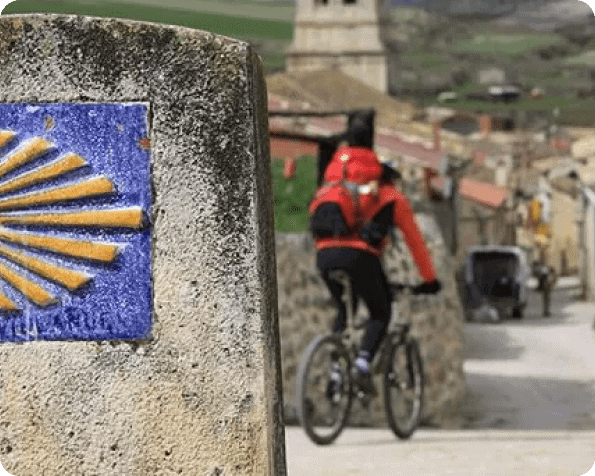
Yes, the Camino de Santiago can be done by bicycle, but the minimum distance to obtain the Compostela is 200 km (compared to 100 km on foot). The most suitable routes for cycling are the Camino Frances and the Camino Portugués, which have better signage and more favorable terrain. You will need to start from more distant points such as Ponferrada or León.
Discover the Camino de Santiago by bike
Is it safe to do the Camino de Santiago?
Yes, the Camino de Santiago is very safe. Thousands of pilgrims walk it every year without incident. The routes are well signposted, there are medical services at each stage, there is a large community of support among pilgrims, and the Guardia Civil and local police patrol regularly. As in any trip, it is recommended to take basic precautions with your belongings.
What is the easiest route of the Camino de Santiago?
The Portuguese Camino from Tui (6-7 days, 120 km) and the Camino Frances from Sarria (5-7 days, 114 km) are the easiest routes. Both have mostly flat terrain, excellent signage, full services at each stage and allow you to obtain the Compostela. They are ideal for beginners, families or people who are looking for a first experience without big slopes.
What happens if I cannot finish a stage?
If for any reason you are unable to complete a stage, you have several options:
- Calling a cab or local transportation to get to the accommodation
- Shorten the stage by stopping in an intermediate village (if accommodation is available).
- Use the 24/7 assistance service (if you contract with a specialized agency).
- Ask for help from other pilgrims or in bars/shelters along the way.
There is no penalty for using transport in any section, although those kilometers will not count for the Compostela.
Can I do the Camino with children?
Yes, many families do the Camino with children. The best options are:
- Camino Frances from Sarria (easy terrain, full services)
- Portuguese Way from Tui (flat and short)
- Leisurely pace: 10-12 km/day max.
- Private accommodation by reservation (more comfort)
- Luggage transfer included
- Planning recreational activities in villages
Children from 8-10 years of age tend to enjoy the experience very much.
Where do I keep my belongings while walking?
If you hire a luggage transfer service, your large backpack goes directly to the next accommodation. You walk alone with a small backpack (daypack) with the essentials: water, snacks, documentation, cell phone, raincoat and sunscreen. In the lodges there are usually lockers or safe spaces to store valuable belongings.
What do I do if it rains during the Camino?
Rain is common, especially in Galicia. Be prepared with:
- Quality raincoat or waterproof poncho
- Waterproof cover for backpack
- Footwear with good grip (mud may be present)
- Spare clothing in watertight bags
- Positive attitude (many pilgrims say that rainy days are memorable).
Most of the stages can be done perfectly well in the rain. In case of heavy storms, it is better to wait in a shelter or bar.
Are there ATMs on the Camino?
Yes, ATMs are available in most towns with services. However, in very small villages there may not be. We recommend:
- Carry enough cash for 2-3 days
- Using credit/debit cards in hotels and restaurants
- Cash withdrawals in large towns (Sarria, Portomarín, Palas de Rei, Arzúa).
- Always carry some cash (some hostels and small bars only accept cash).
Plan your Camino de Santiago without worries
How to plan the Camino de Santiago? Organizing the Camino de Santiago on your own can be complex: coordinating accommodations, luggage transfers, transportation to the starting point, and making sure everything is ready for each stage.
What if you could delegate all the logistics and just focus on walking?
In Santiago Ways we specialize in organizing your pilgrimage in a personalized way, adapting to your available days, pace and preferences. Since 2015, we have helped thousands of pilgrims to live their Camino without logistical stress.
What we include:
- Selected accommodations with private bathroom
- Daily breakfast
- Luggage transfer between stages
- 24/7 assistance throughout the Camino
- Exclusive app with GPS and offline maps
- Pilgrim’s credential
- Optional travel insurance
- Flexibility to add extra nights or rest days
You just walk. We take care of the rest.
Conclusion: Your Path starts here
Planning the Camino de Santiago step by step allows you to enjoy a stress-free experience, adapted to your needs and pace. Remember the fundamental steps:
- Choose the season (spring or autumn recommended)
- Select your route according to available days
- Define your pace (15-18 km/day ideal for the first time).
- Book accommodation in advance
- Organize logistics (transfer, transportation, insurance)
- Pack light (maximum 10% of your weight).
The Camino de Santiago is a unique experience that combines physical exercise, nature, culture and personal growth. With good planning, you will live each stage to the fullest.
Ready to take the first step?
Everything you need to plan your Camino
Discover our organised Camino de Santiago routes with options adapted to different fitness levels, travel durations and types of experience, from the Camino Francés to the Camino Portugués or the Camino del Norte.